Showing posts with label Poland. Show all posts

Wednesday, July 14, 2010

Krakow (Part II)

Day 6, 7: Krakow, Poland (continued)

The best thing about Krakow was the opportunity to see slivers of non-touristy stuff (museums, churches, and the like). We were lucky enough to stumble upon a Polish Renaissance Faire, which totally made my day!! It was a weekend event along the Vistula River under Wawel Hill, and most of the people there seemed to be from the area.

This was a station where you could make those traditional Polish hair wreaths.
Now you see why lots of fashion models come from Eastern Europe...

The Old Town square was pretty fun for people-watching. As I mentioned earlier, I liked this area a lot because it was really really big and clean, lined with cafes and their brightly colored potted plants. It was a real local feel. Of course there were some touristy stuff, like...

I love the expression on my mom's face, it's like she's seeing a leprechaun or unicorn... except this is a sad old trick, commonly executed in Times Square, New York! To be fair, their costumes WERE the best I've seen on a "human statue", and my mom was so tickled that she paid to take a picture with them. Stimulating the local economy is never a bad thing. :)

Pigeons. Also known as cockroaches that fly.
I yelped while taking this photo... some guy thought it'd be hilarious to start throwing bread crumbs at me.

Here are some unavoidable jumping shots, which were fun for the first minute until I realized that my mom had nooooooooo idea how to take a picture, making me jump literally a hundred times with no air to show for it. (I seriously think that 99.99% of Asian mothers are technologically incompetent, often choosing to physically unplug the TV rather than push the on/off button on a remote control.) This is one of the less awkward ones that she took, which doesn't have me looking like I'm squatting to take a crap. My mom looks fabulous though. :)


We also went to the weekend flea market in Kazimierz, the old Jewish district. The market was at their main square called Plac Nowy, which was actually quite dirty and unkempt. If you only had one day in Krakow, I'd recommend you skip out on Kazimierz. The stalls did have a few interesting things, but New York also has some pretty kick-ass flea markets and at the end of the day, unless you know what you're looking for, your eyes start to get swirly real fast.

Knick-knacks.

FACTOID: Did you know bagels originated from Krakow?!
An obwarzanek krakowski stand with its sour-faced owner. I asked his permission to take this photo, actually. I'm also probably the nth person that day to do so (but no I didn't buy a bagel, haha).

I was tired of Polish cuisine at this point and all their pierogi Chinese dumpling business, so I decided to try some Russian fare for change since I figured this was the closest I'd get to its borders. Since I couldn't read the menu, I asked the waitress for some authentic dishes to recommend, and THIS is what she brought me:

... freaking Russian wontons. GAHHHHHH!!! After looking this up online, I think they're called pelmeni.
You like pierogi, I like pelmeni. You like tomato, I like tomahto.
Pierogi, pelmeni, tomato, tomahto... let's call the whole thing off!

But then I had a splendid dark Ukrainian beer, got tipsy, and forgot how much I disliked pierogi/pelmeni in no time. :)

Tuesday, July 13, 2010

Krakow (Part I)

Day 6, 7: Krakow, Poland

Ohhhh boy! I have too many photos of Krakow, all of them worth sharing. I think for this post I'll focus on the main attractions, and for the next one I'll cover more of the quirky things I observed.

Stare Miastro (Old Town), Krakow
Bunny ear covers (or devil horns)!

I loved Krakow. It was virtually unscathed from WWII and has thus been able to successfully preserve its historic architecture and wonderful old town feel. Krakow is a UNESCO World Heritage site, and I recommend everyone travelling through the Central European region to spend at least a day or two in town. Out of all the places that I've been on this trip, Krakow is by far the cleanest and most navigable city. My mom loved going into all the cute shops, which were interesting because they were mostly small mom n' pop and locally owned (I can't stand going to globally branded shops when I'm on a trip, unless I've run out of underwear or something). I can't even tell you just how many amber jewelry stores went into, but whatever makes mom happy... :) As you can see, there are also a lot of street-side cafes in the old town market square, which were all very nice for people/horse-watching and well-brewed cappuccinos.

St. Peter & Paul's Cathedral (1600's - late Renaissance) // Church of St. Andrew (1000's - Romanesque)
Having these two churches stand next to one another makes me ponder about the cultural evolution of mankind (deep, I know... haha).

Legend has it that Krakow began as a settlement on Wawel Hill, which overlooks the Vistula River. Unfortunately, there was a dragon that liked to snack on fair maidens living in a cave under the hill (I think we know where this story is going). Some clever guy killed the dragon by tricking it into eating sulfur, which made it really thirsty and so it subsequently drank itself to death. Haha, what a silly dragon!

Smok Wawelski (the Dragon of Wawel Hill)
Oh how far you have fallen...
Once able to bring terror into peoples' hearts, now just a lowly babysitter.

Krakow was the seat of Polish royalty for hundreds of years until 1596, when a Polish-Lithuanian alliance made it more logical to move the capital to Warsaw for geographical reasons. Even still, Krakow has always maintained its position as the cultural hub of Poland.

THIS is how you move the capital of Poland.
I may read too many fantasy books.

Wawel Hill.
By the way, the Poles pronounce their "W's" like "V's", so the correct way to call it is "Vavel". i.e. Warsaw = Varshava.

St. Mary's Basilica.
This hall was so freaking bad-ass. Visitors had to pay extra to take photos inside this church, but I managed to sneak a haphazard one in. There were tons of people who got caught (The Fine = 6 zloty & lots of evil stink-eye).

'God in the Act of Creation' by Stanislaw Wyspianski in St. Francis' Basilica.
I dragged my mom to see this, which is considered one of the greatest modern stained glass windows in the world. It makes me so not want to mess with God.

To Be Continued...

Monday, July 12, 2010

Auchwitz-Birkenau

Day 5 (continued): Auchwitz I, Auchwitz II-Birkenau concentration camps

I've been aware of the Holocaust ever since elementary school... but the text, the images, the numbers, never really stirred up any deep empathy or understanding. There's always been a generational, geographical, cultural barrier, and all of these crimes just seemed too horrific to be real. Well, after this trip to the Auchwitz concentration camps, I'll never ever feel the same. It WAS real, yet still surreal... completely unimaginable that humans could easily kill millions of other humans for the most mind-boggling reasons.

"Arbeit Macht Frei"
Work makes one free.
The "B" is inverted here on the Auchwitz gate, which many speculate was made by political prisoners to warn others about the true nature of the concentration camps.

Over one million people died in Auchwitz, most of them Jews, but also Poles, Soviets, gypsies, and those of other nationalities. Most people were executed within 2-3 hours of arriving to Auchwitz via being corralled on train. All the elderly, young, and most women (pregnant, mothers) were sent to the gas chambers right away. After they locked the doors and gassed their victims, the Nazis then pillaged the bodies by pulling out gold teeth and shaving off all their hair. All those who arrived on Auchwitz had their heads shaved, which were packaged and processed to be made into industrial fabric for bedding, tents, and clothes. I saw with my very own eyes rolls of this fabric... which if you looked closely had strands of hair sticking out on the side.

There were several galleries where the Auchwitz museum displayed a countless number of personal effects. There was a room full of childrens' shoes. Mounds of luggage. Piles of toothbrushes. A case-full of glasses. Each of these belonged to A PERSON. These belongings not only represented an individual, but a false hope of a new beginning... which was lie the Nazis freely employed. I didn't take any photos of these items out of respect to the victims, and because I didn't want to bring back these "digital souvenirs" back with me.

One of the "Living Barracks" in Auchwitz-Birkenau.
Even if you made it through the initial selection process, being alive in Auchwitz was often worse that dying immediately in the gas chamber.

I felt physically ill being in Auchwitz, a strange burdened sensation. I went into the gas chambers, the cremation rooms, the living barracks. I saw the firing block, the isolation cells, the sentry towers. Even though I saw all this, I still can't really believe that it happened.

Auchwitz II-Birkenau.

On a final note, I would like to convey to all my fellow travelers an very important rule to keep while visiting foreign places: ALWAYS maintain a level of respect for the locals and their culture/history. I saw four tourists from Hong Kong who decided that it would be fun to take their ultra lens professional cameras and do an impromptu photo shoot at the barbed wire in the Birkenau concentration camp. The girl wrapped a scarf around her head and then peered "pensively" through the fence. WHAT... THE FUCK. YOU CANNOT EMULATE A CONCENTRATION CAMP VICTIM, BITCH. THIS IS NOT YOUR ANNUAL SCHOOL FIELD TRIP. I hate to use foul language on a public blog, and it's my fault for being unable to find the right words to adequately convey my rage and embarrassment (being a person of Chinese descent myself). I should have gone over and explained to them that this is a place of suffering and remembrance, a graveyard. How would they feel if people pretended to be slaughtered at the Rape of Nanjing Museum?? Ignorant idiots, you make me sick with your insensitivity.

Okay, with that rant out of the way, I would like to disclose that I had the honor of meeting a Holocaust survivor in my tour group, who shared her story with me (when we were chatting in the hot tub in Budapest). It was her first time back in Poland since she fled her home at the age of 8. She disclosed to me how her father fought for the Polish army, how she moved from town to town, how her family hid in the woods for 10 days without food or shelter when the Nazis raided their village (and her grandfather was executed by firing squad immediately). She told me how her mother knew short-hand German and got the entire family fake papers, and managed to get her aunt and uncle out of the Warsaw Jewish Ghetto when her mother got wind that it was going to be liquidated (and all of their inhabitants sent to the concentration camp). She told me how she had to memorize her fake name, her parents fake name, a fake history. Her family made fake backs for their closets so they could hide their relatives. The policemen inspected houses very often, and her parents hid rocks in the house in case they were discovered... this was so they could all attack (and all die) together. Finally, even after the Soviets took over Poland, her parents had the foresight to be amongst the first to seek asylum and go to America. I am so grateful that she shared her history with me, not only because I know that it was difficult for her to visit Poland, but also because her story again solidified the significance of the places that I was seeing. Thank you, Eva.

Friday, July 9, 2010

Crashing Czestochowa

Day 5: Jasna Góra Monestary in Czestochowa, Poland

En route from Warsaw to Krakow, we stopped by Czestochowa to visit the Black Madonna shrine in Jasna Góra Monestary. Founded in 1382, this place is considered an important pilgrimage point and spiritual capital for all Roman-Catholic Poles (90% of the population).

The interior of Jasna Góra Monestary.

Renovations.
It's better than working by candlelight like the good old days. :p

The Black Madonna icon is Poland's holiest relic and it is believed that the Virgin Mary in this portrait can magically heal and protect those who believe in and worship her. Various offerings given to the Black Madonna as proof and a show of appreciation of her help.

Crutches! People also gave jewels, intricately brocaded cloths, tapestries... but those were in the Treasury and I wasn't allowed to take photos there.
Didn't find a bejeweled wheelchair... :p

We were taken to the Black Madonna shrine as part of our tour, but Mass and a priest ordination was going on at that time. I can't tell you just how awkward that whole ordeal was... even if I were a Roman Catholic, inserting myself into a rite of ordination feels super intrusive unless I was friend or family. Well, the imagine a bunch of Americans with cameras hanging off their necks filing through the hall, some taking photos and forgetting to turn off their flash. In the meantime, a priest is singing some holy text and hundreds of devout Poles are praying in the back of the church (and giving you the evil eye?). It was just weird and embarrassing. And of course I didn't stand out at all, being an Asian female and obvious tourist.

My hidden camera skillz. I think the man sitting in the lower left corner is the one being ordinated as we're passing through.

Tuesday, July 6, 2010

Warsaw: Polish Fighters

Day 3, 4: Warsaw, Poland

Oh Warsaw, or as the Poles call their capital city: Vahr-shava...
You are a field of broken dreams and indefatigable spirit.

85% of Warsaw was razed to the ground by Nazi Germany after the Warsaw Uprising of 1944. The citizens of Warsaw planned their own series of attack (by themselves!) against the Germans after being suppressed throughout WWII... without the help of the Soviets who stopped short across the Vistula River. The Poles were crushed, of course, and the Red Army conveniently rolled in afterwards and easily captured the flag. Before retreating though, the Germans systematically blew up buildings in Warsaw using a list based on most important cultural relevance (churches, castles, schools), so that they could effectively wipe out Polish identity. As if this really needs to be said, but the Nazis were truly evil people.

Stare Mestro, Warsaw
A UNESCO World Heritage Site
The mermaid holding a sword and shield is Warsaw's symbol and can be found all over the city. She ain't no Ariel!!

After WWII, Poland became a part of the Communist Eastern Bloc. Somber heavyset Soviet-style buildings were erected from the ruins, as well as a complete rebuilding of Warsaw's completely flattened Old Town (Stare Mestro). Or, should I say New Old Town since the buildings there are only ~50 years old? I couldn't believe that this city that I was visiting was only around 5 decades old, and we had all this infrastructure and people around us. The Poles came back to broken families and a broken city, and decided that rather than leaving it all for dead, they would rather start anew. Simply amazing!

A small street-side memorial
"John Paul Two (We love you!)"

Poland being one of the most devoutly Roman Catholic regions in the world, Poles consider Pope John Paul II, whose original name was Karol Józef Wojtyła, to be one of their country's heroes. JPII was the first non-Italian pope since the 1500s, and the only Polish one as of date.

A memorial for Lech Kaczynski outside the Presidential Palace.

If you read/watch the news then you know that in Spring of 2010 Poland's President, Lech Kaczynski, as well as almost 100 people on board, died in a plane crash en route to Russia to commemorate the Katyn massacre. For some reason they crammed a large number of ministers and officials all on this one plane... and so in just one day the country lost many of its government administration. Even though Kaczynski was not politically popular before his death due to his ultra-conservative policies, the loss of the head of state as well as the nation's public servants was yet another trauma to the Polish people. Kaczynski and his wife, despite having only served as president for 5 years, was buried in the Wawel Catherdral in Krakow (my next destination!), which is normally reserved for kings and royalty. Because of Kaczynski's untimely death, another election for president was arranged -- acting President Bronisław Komorowski vs. Jaroslaw Kaczynski -- Lech's identical TWIN. Results came out just 2 days ago: Kaczynski lost.

We had a nice traditional home cooked meal at a Polish couple's home. The best part was the vodka infused with herbs. I had a couple shots of that, to my mother's extreme dismay... which was the cherry on top. :)

Why HELLO, my Leonardo DiCaprio doppelganger cab driver! Oh, you're learning English on a Post-It? Heh heh... I can help you with that, although I don't know why "shoot up like mushrooms", "flabby", and "baboon" are on the top of your list... *confused*

A meat stand @ the daily open-air fresh food market. So much delicious consumables, but how do I prepare any of this with just a hot water kettle in the hotel? :( Another sad day for Miffy's stomach.

Monday, July 5, 2010

Berlin in a Nanosecond

Day 1: Stuck unceremoniously at Heathrow Airport for 8 hours.
Day 2: Berlin, Germany. Half-day train ride to Warsaw, Poland.

We flew British Airways from New York to Berlin, with a layover at London's Heathrow Airport. Nightmare of my life! Our tour company that booked our flights to Berlin decided to be clever and gave us only 1 hour breathing room between connecting flights, so of course we missed it and couldn't get into Berlin until half a day later than expected at 8pm, making Day 1 officially a wash. I can totally empathize now with those travelers stranded in Heathrow because of Eyjafjallajokull. And what's with this EU VAT of 17.5%?! Oh wait, so THAT's what happens with you live in a welfare state!

A note about British Airways -- they have the most peppy and charming flight attendants ever! I do enjoy being called "darling" once in awhile. :) I bought a Longchamp bag on their duty-free shop, which ended up being $75 compared to the normal retail price of $145 in the US. Can someone please explain to me why there's a ~50% price discrepancy here (aside from the currency fluctuation)? I'm sure there's an Ebay arbitrage here, haha.

Because our tour was focused on Eastern Europe, we were only alloted one day in Germany (considered to be part of Western Europe). However, it was a really appropriate starting point to kickoff the tour so we could gain some reference in regards to Nazi Germany and the Soviet iron curtain.

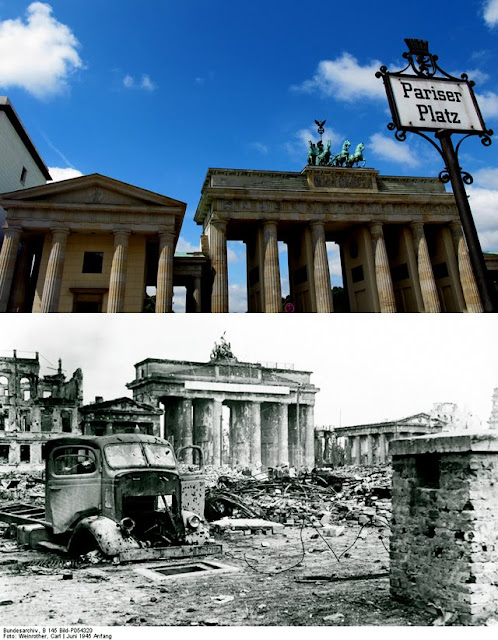
Pariser Platz - where Berlin and Germany's most famous landmark, the Brandenburg Gate, is located. 2010 vs. 1945

What's left of the Berlin Wall. Stupid tour director only gave us brief glimpses as we sped down the road. I'm docking 10 points from Grand Circle Tours. We also got to go to Checkpoint Charlie, a crossing point between East/West Berlin during the Cold War, where you can pose with handsome German boys posing as American soldiers for 1 Euro.

Our tour guide: "To give you some insight as to how we Germans do things, do you see the tags on the trees lining the street? Yes, we've numbered every single tree in the city. That's how we know there's 1 tree per 3 people!" Yes, indeed... no wonder Germany is considered to be the economic engine of Europe.

It was a shame that we couldn't spend more time in Berlin, because I really did enjoy it there. I wish I could have gone to a sports bar there and watched Germany play at the World Cup!! People were flying the German flag EVERYWHERE... the last time I saw something like that here in New York was after 9-11. Anyway, Berlin streets are wide and clean, and I found the architecture to be very creative. They love covering their funky-shaped buildings with splashes of color and a layer of glass. The whole city felt like a well-oiled machine. Some liken Berlin to New York, but I think that there's just too much urban sprawl to make that analogy true, at least in terms of civic planning. Perhaps it's the whole sophisticated feel and busy atmosphere that does the trick though.

Before we knew it, we were swept towards Warsaw on a 6 hour train-ride through the Polish countryside. It was fun, relaxing, and I had my first foray into pierogi in the dinner car, which are really just like Chinese dumplings filled with sauerkraut and minced meat.

Das ist alles.

Addendum: I just read this article and found it really interesting and relevant. Sorry it's not linked (and copy/pasted), I'm too cheap to have a WSJ subscription and so the article expires in 7 days.

Many Germans Would Rather Waive the Flag (WSJ)
by James Angelos

BERLIN—German flags have sprouted like red, black and gold wildflowers across Berlin this summer. They're appearing on balconies, cars, bicycles, storefront windows, even painted on children's cheeks. Few can match Youssef Bassal's.

Eager to show his enthusiasm for Germany's soccer team during the World Cup, Mr. Bassal, a 38-year old Lebanese immigrant, unfurled a 60-by-15-foot German flag a few weeks ago, on the facade of the building that houses his cell-phone store.

Mr. Bassal knew his Fahne, as the Germans call it, would draw onlookers. What he didn't anticipate was the reaction—outrage.

During the flag's first night on exhibit, Mr. Bassal says, two youths tore it down and tried to set it on fire. Mr. Bassal ordered a new flag, and this time hung it so that it was harder to reach from the sidewalk. Shortly thereafter, a masked group of nighttime marauders showed up, and the second flag disappeared, he says.

Police suspect the culprits are members of Berlin's radical leftist scene. For them, the enormous flag is nothing less than a provocation, a repugnant display of German nationalism.

Across Germany, the story of Youssef Bassal's flag has become a sensation. Since the vandalism began, a steady stream of television crews and reporters have shown up at his little store, here on a street nicknamed "Arab Alley" in Berlin's Neukölln neighborhood, known for its large population of Arab and Turkish immigrants.

That a man from Lebanon named Youssef has gone to such lengths to display and defend Germany's flag—a symbol many Germans themselves are ambivalent about—has forced many here to question the stereotypes they harbor about the country's immigrant population. Immigrants are generally referred to in Germany collectively, often derisively, as Ausländer, foreigners.

None of that worries Mr. Bassal.

"I love Germany," he said. "Germany helped us a lot. Germany fed us and clothed us. They gave us everything."

Mr. Bassal and members of his extended family fled to Germany from a war-torn Lebanon two decades ago. He started his business in 2001, and his two children were raised in Germany, including his 6-year-old "soccer addicted" son, who, Mr. Bassal says, aspires to play for the German national soccer team. Though Mr. Bassal isn't technically a German citizen (he said he hasn't gotten around to applying), he calls himself "almost German."

Not all Germans see it that way. That afternoon, a small car adorned with three small German flags pulled up in front of the store. Three elderly passengers emerged to behold Youssef Bassal's flag.

"I wanted to see what it really looked like," said one of them, as she gazed with wide eyes. She said she heard about the giant flag on the news. "When the Turks feel like Germans, I find that beautiful," she said, wrongly assuming the cousins to be Turks, who comprise Germany's largest ethnic minority. "It's good that they feel like us."

Attitudes such as these befuddle Ibrahim Bassal. When one woman stopped by the store and asked him why the Bassals didn't put up a Palestinian flag instead, he answered, "Why would I?" Equally perplexing, said Ibrahim, have been those who accuse the cousins of stoking nationalism.

"Give me one reason why I should take it down?" he said defiantly. "What does football have to do with nationalism?"

Because of Germany's ultranationalist World War II legacy, exhibitions of national pride until recently have been something of a taboo here. That changed rather suddenly in 2006, when Germany hosted the World Cup and Germans began displaying their national colors more freely. Then-President Horst Köhler welcomed the shift as a "returning to normal," though not all Germans remain entirely comfortable with the new expressions of patriotism.

The Bassal cousins say their patriotism has nothing to do with the evils that transpired long before they immigrated to Germany. Rather, they say, the flag is an expression of the good life they've built here.

"Actually, this is the first time that I've had a problem in Germany," said Youssef, as he took a drag from a cigarette. "They destroyed my flag."